The Community Foundation “Korçarët Ndihmojmë Korçarët”, as part of the second phase of the project “The Young Creators of Korça’s Future,” has announced the best ideas selected by the Idea Evaluation Committee.
The Community Foundation “Korçarët Ndihmojmë Korçarët”, as part of the second phase of the project “The Young Creators of Korça’s Future,” a project aimed at encouraging creativity and the courage to express innovative ideas among young people aged 14–22, has announced the best ideas selected by the Idea Evaluation Committee. In total, 18 ideas were submitted by 45 young participants coming from educational institutions within the Municipality of Korça
The Community Foundation “Korçarët Ndihmojmë Korçarët," as part of the second phase of the project “The Young Creators of Korça’s Future,” a project aimed at encouraging creativity and the courage to express innovative ideas among young people aged 14–22, has announced the best ideas selected by the Idea Evaluation Committee.
In total, 18 ideas were submitted by 45 young participants coming from educational institutions within the Municipality of Korça, including the Foreign Languages School “Faik Konica,” “Platon” High School, “Ymer Dishnica,” “Themistokli Gërmenji,” “Raqi Qirinxhi,” Preka College, the 9-year school “Sotir Gurra,” “Mësonjëtorja e Parë,” and Fan S. Noli University of Korça.
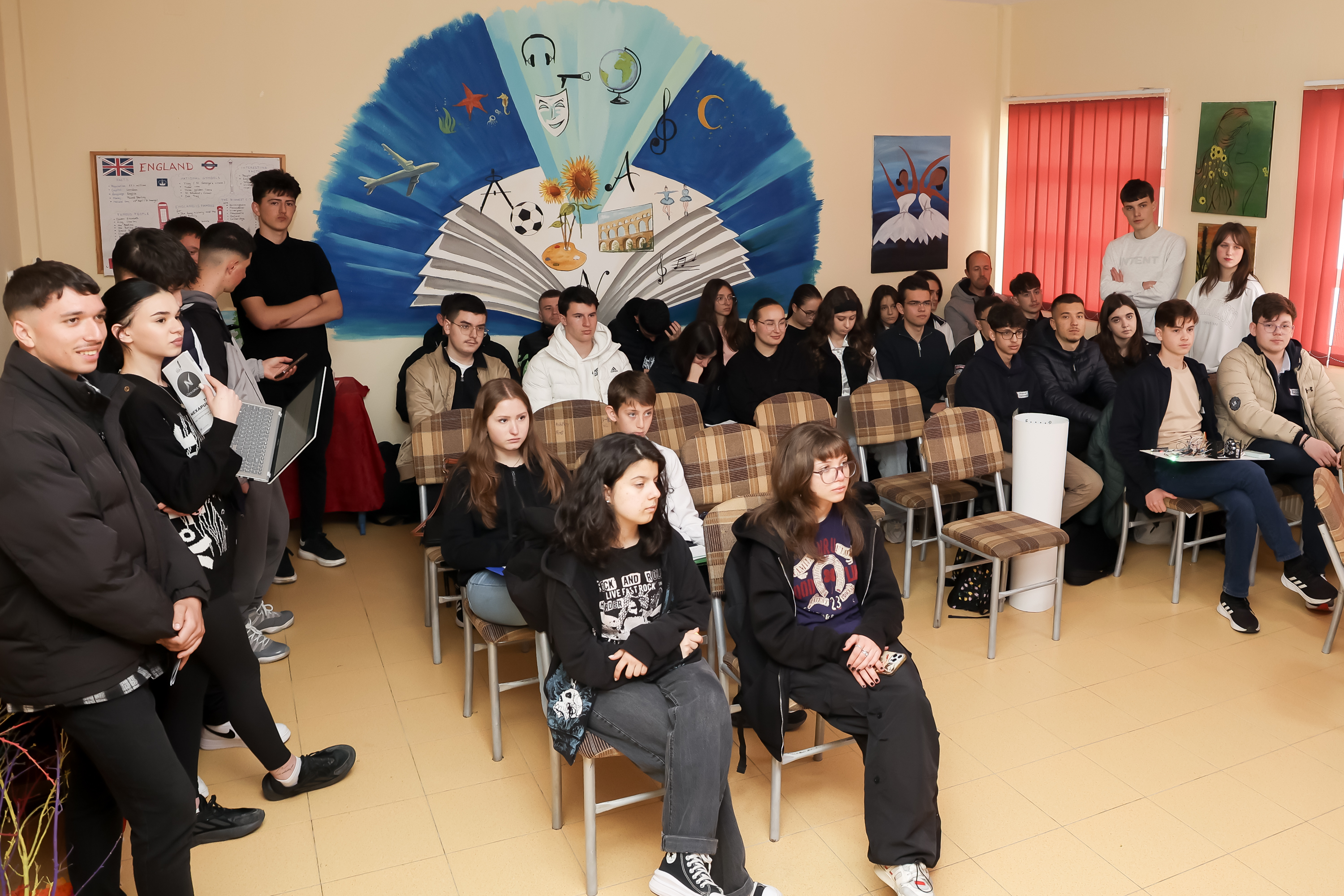
The Idea Evaluation Committee, composed of engineer Antoneta Gjinko, Professor Marijon Pano, and Petri Pene, on April 22, 2026, after evaluating the ideas presented in the respective applications, also conducted an open hearing where all applicants had the opportunity to explain their ideas in detail in the presence of all participants.
At the conclusion of the open hearings, the Evaluation Committee determined that the most outstanding ideas were those of the following young participants:
Xhersi Kodra and Klea Kosho, “Platon” College, with “The Nexapulse,” a futuristic idea for a bio-engineered, self-repairing vehicle designed to address issues such as pollution, high energy consumption, and frequent damage to traditional vehicles. This idea presents a transport system that does not function merely as a mechanical machine but as an intelligent structure that generates energy from organic sources, adapts to environmental conditions, and can regenerate its own parts when damaged.
Bergi Mema, Arber Dacolli, Enzo Ramollari, Johana Naco, Frenk Samsuri, and Preka College, with the idea of building an ultrasonic levitator, a device that defies gravity by keeping small objects suspended in the air without any physical contact.
Anjel Bala, Nikola Bardhi, Olga Xheka, Gabriel Zhiva, and Natali Llogori, “Raqi Qirinxhi” High School, with the project of an agricultural robot designed to ease farmers’ work and save time and energy. This robot functions as a small autonomous machine that moves across land and can assist in processes such as planting, irrigation, and monitoring plant conditions.
Ervis Ogreni, “Ymer Dishnica” High School, with the idea of reviving arcade games, specifically an intelligent, interactive football stadium where two players play together using joysticks.
Roel Haredini, Hermes Xhemollari, Angel Qyteti, and Vangjush Xhialli, “Themistokli Gërmenji” High School, with the idea of a smart greenhouse monitored in every aspect, including temperature, artificial lighting, automatic irrigation, etc.
Roela Riza, Kristi Ramo, Jona Terrolli, Albi Mulla, and Medi Terolli, “Themistokli Gërmenji” High School, with GENEX, an innovative solution addressing transportation challenges in modern cities. The application provides users with clear information about fuel and charging stations, as well as a calculator for the real cost of travel.
GENEX aims for real-world implementation and represents a concrete step toward smart cities. At the core of the system is the GENEX device, a small and low-cost module installed in vehicles that transmits their position via GPS and communication networks. This enables the creation of a dynamic traffic map, transforming the city into an intelligent and interconnected ecosystem.
Albi Larti, Albi Trungu, Gisela Kulla, Xhimi Baraku, Greis Becolli, and Preka College, with the “Solar Tracker” system, which increases the efficiency of solar panels by automatically orienting them toward the strongest light source.
As intended, this project identified and supported young people (aged 14–22) who brought forward creative ideas, prototypes, and new inventions in various fields such as technology, energy, environment, agriculture, security, etc.
The third phase now follows, consisting of guidance courses and mentoring, which will be supported with mini-grants for prototype development.
After that, the final phase will be the “Demo Day” event, where all selected ideas will be brought to fruition.
In accordance with the instructions of the Ministry of Education, all activities will be held after school hours, on coordinated days and times, including non-school days, in full coordination with the Regional Directorate and the management of educational institutions. Participation of young people has been carried out with prior approval and support from parents.
The Community Foundation “Korçarët Ndihmojmë Korçarët” once again takes the opportunity to thank and express its gratitude to Dr. Yvonne Naum, the founder of the foundation, for her generous sponsorship of this project, together with the Global Albanian Foundation, Credins Foundation, Easypay, Vision OJF, National Commercial Bank, Kredo.al, Youth4Society, Grant Thornton Company, Shefqet Avdullari, and Mentor Kikia, as well as Partners Albania, who, through the “Giving Circles” event, made possible the above-mentioned sponsorships that brought this project to life.